
Stop Incessantly Scrolling - Jonathan Voos

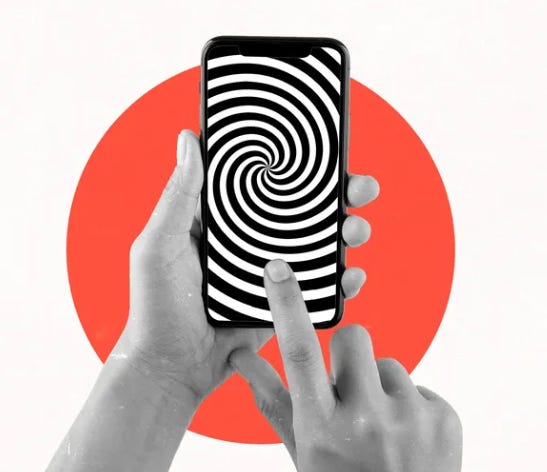
Put your dang phone down and focus on what is good
August 11, 2024
Dear reader,
Phone addictions are a real problem. I rarely go a day without scrolling on my phone for multiple hours at the expense of developing real relationships with people. To help rectify this, I have entirely deleted Instagram and Snapchat, completely offloaded Twitter, and only use LinkedIn on Safari.1 Things are starting to improve. Yet I still spend far too much time on LinkedIn, watching sports, or scrolling the news, and far too little time doing things that matter. This problem is not unique to me.
Many Americans can’t even put their phones down for long enough to have real conversations with their own families—a phenomenon Time Magazine termed “phubbing” (phone-snubbing). I don’t think this silly name does justice to the seriousness of the problem. When we “phub” someone, our actions say that the thoughts of random people on the internet are more important to us than the lives of the people we love.2 Should not the problems and experiences of our family and close friends be more important to us than what Elon Musk says on X, Lester Holt says on NBC, or WeRateDogs says on Instagram?3
The devices that theoretically enable us to connect with almost anyone at any moment are ironically the key drivers in the rise of loneliness, distraction, and isolation. We now have all of the knowledge (and misinformation) of the world at our fingertips. Yet, if most recent studies on mental health are indicative, we are much less happy. More cynical Christians than I have long said it’s no coincidence that iPhones are made by a company whose logo is an apple with a bite out of it.
Apathy runs rampant in America. We are in a nationwide daze and collectively seem either unwilling or unable to break out of it. Everything seems negative. People are spiritually, mentally, and emotionally confused. How do we break this cycle?
Put your dang phones down and be grateful for goodness’ sake.
We are what we eat. Or, in this context, we are the way we spend our time. If we spend our time consuming negative ideas on social media and in the news, we are very likely to become more negative as a result. This concept is simple. See Proverbs 13:20; see also Heart of Stone (part of my testimony); Flying Horsemen & Gratitude (same).
And this concept has a biblically prescribed action plan. Phillippians 4:4–9 tells us not to be anxious but to rejoice, pray, and focus on things that are true, honorable, just, pure, lovely, commendable, excellent, and praiseworthy. Habakkuk 3:17–19 exhorts us to rejoice in the Lord even if everything in our lives reflects the US men’s 4X100 relay team anytime an Olympic finals race comes around. And Romans 12:1–2 says:
I appeal to you therefore, brothers, by the mercies of God, to present your bodies as a living sacrifice, holy and acceptable to God, which is your spiritual worship. Do not be conformed to this world, but be transformed by the renewal of your mind, that by testing you may discern what is the will of God, what is good and acceptable and perfect (emphasis added).
When we focus on what is good, it is much harder to dwell in our dissatisfaction or unhappiness. Focusing on what is good and “being transformed by the renewal of [our] mind” starts with spending time in God’s Word and with family and Christian community. We can’t focus on what is good or on much of anything else when all we do is scroll.
So, for everyone’s sake, put your dang phone down and turn off the dang TV more often so that you don’t damage important relationships. Our limited time on this Earth is God’s—not our own. E.g., 1 Corinthians 6:19–20 (you are not your own, for you were bought at a price); Matthew 25:14–30 (parable of the talents); Ephesians 5:15–21 (make the best use of time). We must be careful about how we use it.
Comments