
Shadows of Heavenly Things - Jonathan Voos

On Blood, the Veil, & Copies of Heavenly Things in Hebrews 8–10
Dear reader,
Merry belated Christmas! I hope you all have a wonderful holiday season spending time with your families and celebrating the birth of Jesus Christ. In this post, I want to talk about three themes that have stuck out to me during my December study of the Book of Hebrews: shadows, blood, and the tearing of the veil of the old covenant.
Hebrews is complicated, and some of these themes are subject to interdenominational debate. I don’t claim to have all the answers nor do I claim to understand the book perfectly. So, I want to start this post off the way CS Lewis starts The Problem of Pain:
“I have believed myself to be re-stating ancient and orthodox doctrines. If any parts of the book are ‘original’, in the sense of being novel or unorthodox, they are so against my will and as a result of my ignorance.” With this in mind, it’s time to turn to Hebrews and another CS Lewis classic: The Chronicles of Narnia series.
The Law as a Shadow of the New Covenant
In The Last Battle, CS Lewis describes the Narnia where the Pevensie children roamed “not the real Narnia. That had a beginning and an end. It was only a shadow or a copy of the real Narnia, which has always been here and always will be here.” The new Narnia (Aslan’s Land, which represents Heaven) was deeper, far more wonderful, and far more real than the former copy.
While Lewis is seemingly painting an allegory of the New Jerusalem in Revelations 21, his language about the shadow or copy could be pulled almost directly from Hebrews. Hebrews 8:4-6 states that Levitical priests who offer gifts according to the Mosaic Law serve as “a copy and shadow of the heavenly things.” On Mount Sinai, God instructed Moses to “See that you make everything according to the pattern that was shown you on the mountain.”
So, the old covenant under Mosaic Law is good and was based on a Heavenly pattern. But it has ended. It was temporary and served as a mere shadow of the fullness of God’s Kingdom. The new covenant under Christ’s kingly priesthood is “much more excellent” because “it is enacted on better promises.”
After all, “We are not like Moses, who used to put a veil over his face to prevent the Israelites from gazing steadily until the end of the glory of what was being set aside.” 2 Corinthians 3:13. Under the old covenant, that veil is not lifted—it can only be set aside in Christ. 2 Corinthians 3:14. Christ removes the veil “whenever a person turns to the Lord,” for “the Lord is the Spirit, and where the Spirit of the Lord is, there is freedom.” 2 Corinthians 3:16–17. Thus, under the new covenant,
“We all, with unveiled faces, are looking as in a mirror at the glory of the Lord and are being transformed into the same image from glory to glory; this is from the Lord who is the Spirit.” 2 Corinthians 3:18.
Because Christ died for us, the veil of the old covenant no longer covers our eyes. While we are in this world, we don’t see the full picture of the perfection of Heaven—we still are “looking as in a mirror” and are being transformed into his image.
Tearing the Veil
But unlike the Israelites under the old covenant, we no longer need a Levitical High Priest to offer sacrifices on our behalf in the inner rooms of the Tabernacle and Temple—the “most Holy place.” Hebrews 9:1-10. The most holy place was separated from the rest of the Tabernacle and the Temple by a curtain. Hebrews 9:3. The High Priest alone was allowed to pass beyond this curtain once a year to offer blood sacrifices on behalf of the people of Israel. Hebrews 9:7. These repeated sacrifices were necessary: “Since the law has only a shadow of the good things to come, and not the reality itself of those things, it can never perfect the worshipers by the same sacrifices they continually offer year after year.” Hebrews 10:1.
But Christ literally tore that veil separating God’s people from the most holy place. Matthew 27:51 says that when Jesus gave up his spirit at his death, “the curtain of the sanctuary was torn in two from top to bottom, the earth quaked, and the rocks were split.”
Christ “entered the most holy place once for all time, not by the blood of goats and calves, but by his own blood, having obtained eternal redemption.” Hebrews 9:12. Unlike the Levitical High Priest who could only repeatedly offer imperfect sacrifices, Christ appeared once to offer a perfect sacrifice, by his blood. Hebrews 9:11–28. Accordingly, all those who believe in their heart and confess with their mouth that Jesus is the resurrected Lord are part of the royal priesthood of Christ our High Priest. Romans 10:9; 1 Peter 2:9; Hebrews 7.
Without the Shedding of Blood, There is No Forgiveness
But why was Christ’s sacrifice necessary in the first place? Why do we need his blood? Hebrews gives us a clear answer—aided once again by CS Lewis.
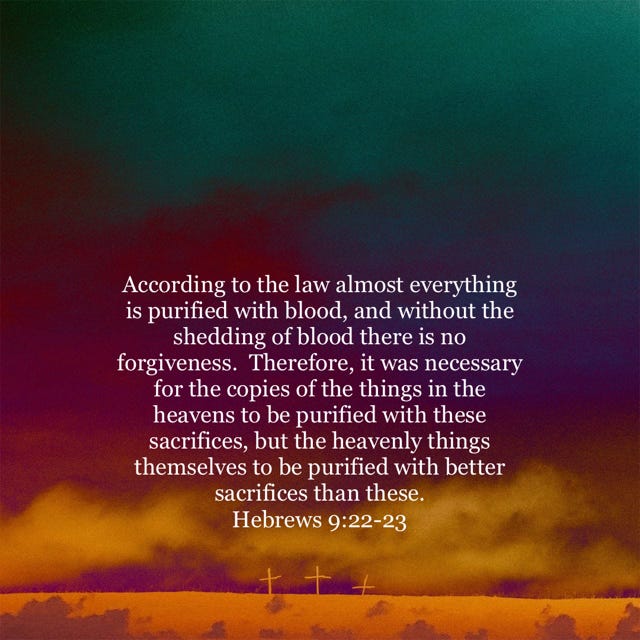
Going back to my earlier discussion of shadows and copies of heavenly things, Hebrews 9:23 says it is “necessary for the copies of the things in the heavens to be purified with these [blood] sacrifices, but the heavenly things themselves to be purified with better sacrifices than these.” In other words, purification through blood sacrifice is part of the order of creation.
CS Lewis once again illustrates this principle well. In The Lion, The Witch, and The Wardrobe, Lewis tells the story of Aslan, the Jesus figure’s, substitutionary sacrifice for Edmund Pevensie, the traitor. Edmund betrayed Narnia by temporarily helping the evil White Witch, and the “deep magic” that created Narnia gave the Witch the right to kill every traitor. Sinners must pay for their sins.
But the Witch did not know the order of creation. When Aslan sacrificed himself on the stone table in Edmund’s stead, he drew upon a deeper, older magic: When “a willing victim who had committed no treachery was killed in a traitor's stead, the Table would crack and Death itself would start working backwards.” Aslan’s death and resurrection for the treachery of another was intertwined into the deepest magic of the order of Narnia’s creation.
Similarly, Hebrews teaches that because the first covenant was inaugurated with blood and was a copy of the fullness of the new covenant under Christ, the new covenant needed to be inaugurated with blood as well. Hebrews 9:22 says that “According to the law almost everything is purified with blood, and without the shedding of blood there is no forgiveness.” Therefore, Christ needed to shed his blood for the forgiveness of our sins because the “deeper magic” of Earth required it under both the old covenant and the new covenant. See Isaiah 53:5 (“But he was pierced because of our rebellion, crushed because of our iniquities; punishment for our peace was on him, and we are healed by his wounds.”).
Biblical Exhortations
Ultimately, because Christ shed his blood for us as a perfect sacrifice that fulfilled the promises of scripture, we can have assurance for the forgiveness of our sins by his saving grace. It seems only appropriate to end this post with the exhortation the author of Hebrews wrote at the inspiration of the Holy Spirit in Hebrew 10:19–25:
Therefore, brothers and sisters, since we have boldness to enter the sanctuary through the blood of Jesus—he has inaugurated for us a new and living way through the curtain (that is, through his flesh)—and since we have a great high priest over the house of God, let us draw near with a true heart in full assurance of faith, with our hearts sprinkled clean from an evil conscience and our bodies washed in pure water. Let us hold on to the confession of our hope without wavering, since he who promised is faithful. And let us consider one another in order to provoke love and good works, not neglecting to gather together, as some are in the habit of doing, but encouraging each other, and all the more as you see the day approaching.
I hope you all have a blessed Christmas season.
Comments