
Faith and Obedience - Jonathan Voos

On Saul's excuses and Jonathan's faith.
Dear reader,
Life changes quickly. My wife and I went on our first date just over two years ago, when she had just started teaching and I was preparing for my second year of law school. We lived forty-five minutes apart and weren't sure the distance was sustainable.
Still she supported me through two demanding years of law school. In that time, I helped start a new conservative law journal, published an article, graduated, and took (and probably passed) the bar. My wife and I are now married, honeymooned, and starting our new jobs.
It’s an exciting season, but life keeps speeding up. Finding insurance is a pain, bills are adding up, and sleep is at a premium. I expect that as our family grows, life will only get busier.
Accordingly, it’s essential for us to form good habits in prioritizing our faith. God has blessed us both with jobs in professions that will allow us to impact the lives of others. In such positions, we must seek Him first in every situation, season our words with salt, and act in accordance with His will. But unless we develop good habits now, discernment, faith, and obedience will only get more difficult.
The urgency of obedience, faith, and discernment especially stuck out to me yesterday during my Bible reading of 1 Samuel 14–16. Today, I especially want to compare Jonathan’s faith with Saul’s excuses in chapters 14 and 15. Like Saul, my tendency too often is to figure out whether things make sense to me rather than relying on the guidance of the Holy Spirit and the fact that God is in control. I believe these passages provide a cautionary tale about relying on my own, flawed reason in situations where God is calling me to more.
God saved Israel through Jonathan’s trust and faith.
Chapter 14 begins by showcasing the faith of Jonathan, son of Saul, in a seemingly hopeless situation. As chapter 13 details, the Philistines had mustered to fight against Israel and were “like sand on the seashore in multitude.” The Israelites “saw that they were in trouble” and began scattering from King Saul, prompting Saul to foolishly violate God’s command and offer a wrongful burnt offering in an attempt to gain favor. After the sacrifice, only about 600 men remained with Saul near the Philistine encampment. And besides Saul and Jonathan, these 600 men seemingly did not even have swords or spears, as “there was no blacksmith to be found throughout all the land of Israel”. Israel was desperate, and Saul waited in limbo.
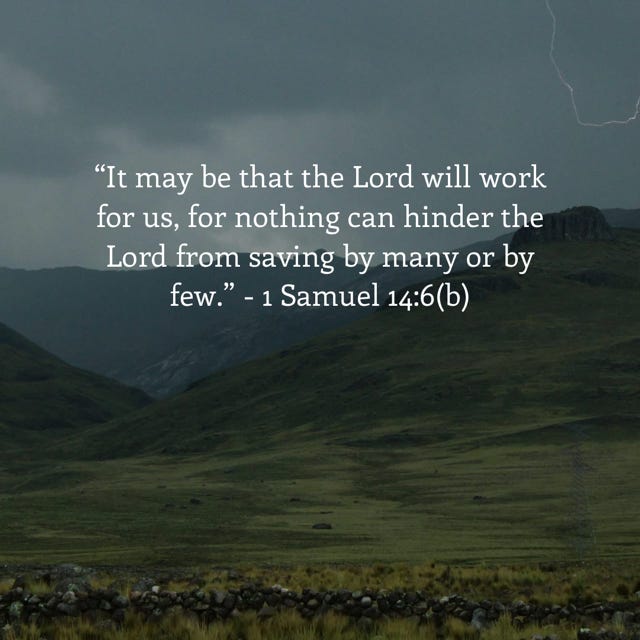
Nevertheless, Jonathan had faith. Without telling Saul, Jonathan and his armor bearer went over to the Philistine garrison, saying “It may be that the Lord will work for us, for nothing can hinder the Lord from saving by many or by few.” They then made a plan, saying that they would show themselves to the Philistines at the narrow entry point and attack if the Philistines told them to “Come up to us.” Jonathan declared that such a response would be a sign that “the Lord has given them into our hand.”
After Jonathan and the armor bearer showed themselves, the Philistines told them to come up. So the men went up and killed around 20 Philistines while God simultaneously induced panic in the camp. The Lord saved Israel that day.
Though the situation seemed hopeless and though Jonathan’s attack made little rational sense, his trust in God led to the salvation of Israel. Jonathan seemingly did not know what the outcome would be before he acted—he said “It may be that the Lord will work for us.” But by attacking and allowing God to work, he showed his faith in God.
Not everything God calls my wife and I to do will make perfect sense rationally. But if God calls us to act, we need to learn how to act faithfully like Jonathan rather than sitting back cautiously like Saul amid uncertainty. Faithfulness is not recklessness because trusting God is not reckless. But trusting God is nonetheless difficult, and I fear that I often am more like Saul than Jonathan in how and when I act.
God Rejected Saul for His Failure to Fully Obey.
We also need to learn how to obey God fully. The cautionary tale of partial obedience in 1 Samuel 15 stuck out to me especially yesterday. In that chapter, God called Saul to completely destroy the Amalekites—all of their people and livestock—because of their sin in opposing Israel when Israel came out of Egypt. Saul went to war against the Amalekites and defeated them. He even devoted himself to the destruction of all the people with the sword.
But Saul spared Agag, King of the Amalekites. He also spared “the best of the sheep and of the oxen and of the fattened calves and the lambs, and all that was good, and would not utterly destroy them. All that was despised and worthless they devoted to destruction.”
Saul did most of what God commanded him to do. But he did not fully obey. In light of Saul’s other failures to trust in and follow God’s commands in 1 Samuel 13 and other previous chapters, God told the Prophet Samuel that he regretted making Saul king.
But when Samuel came to confront Saul, Saul greeted Samuel by saying “Blessed be you to the Lord. I have performed the commandment of the Lord.” At least outwardly, Saul believed that he had completed God’s will.
Samuel responded “What then is this bleating of the sheep in my ears and the lowing of the oxen that I hear?” And Saul told him that the people had spared the best of the lambs and the oxen to sacrifice to the Lord and destroyed the rest.
Even after Samuel confronted him with his sin of following the people, pouncing on the spoil, and doing what was evil in God’s eyes, Saul still tried to justify himself. He again said “I have obeyed the voice of the Lord. I have gone on the mission on which the Lord sent me. I have brought Agag the king of Amalek, and I have devoted the Amalekites to destruction. But the people took of the spoil, sheep and oxen, the best of the things devoted to destruction, to sacrifice to the Lord your God in Gilgal.”
Only after Samuel confronts him a third time does Saul finally recognize and admit to his sin. Because of Saul’s repeated rejections of the word of the Lord, the Lord tore the Kingdom from his hands.
Tearing away the Kingdom for disobedience is a common theme with individual leaders in the History books of the Bible. It happened to the Houses of Jeroboam, Baasha, Zimri, Omri, and the rest of the lines of the Israeli Kings. Because Judah was ruled by the line of David and because of God’s covenant with David, God did not destroy the line of David for the sins of the Kings of Judah. But God did allow the people of Judah to suffer greatly when they were living in sin, which was most of the time.
Obedience is difficult. As Christians, we must strive to have the faith of Jonathan and avoid the pitfalls that come with a lack of trust and faith in God, as shown by Saul. And while I don’t have an exact formula on how to accomplish this outside of striving to grow closer to God and allow the Holy Spirit to renew and transform my mind as Romans 12 prescribes, Hebrews 11 provides dozens of examples of great faith throughout the history of the Bible. I hope you will read those examples and be encouraged by God’s goodness.
Comments